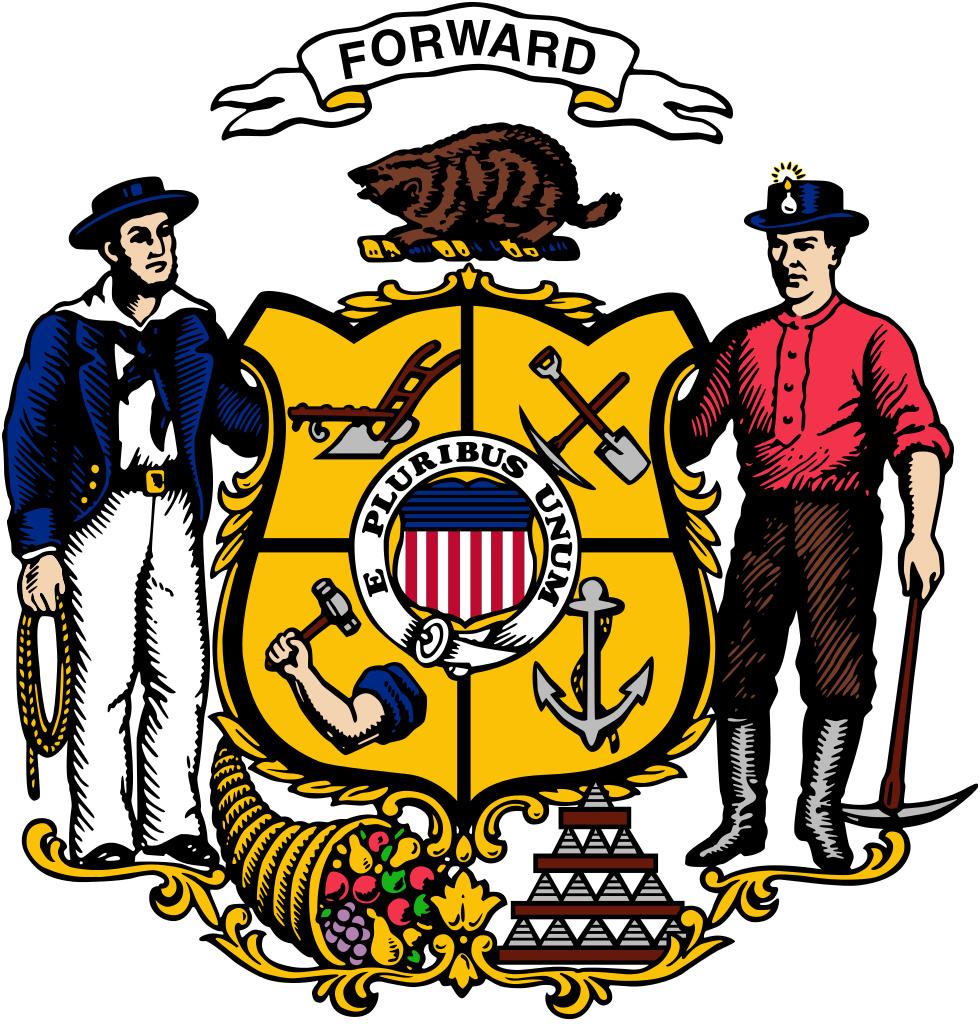
Great seal of the state of Wisconsin; public domain image on Wikipedia.
Official State Seal of Wisconsin
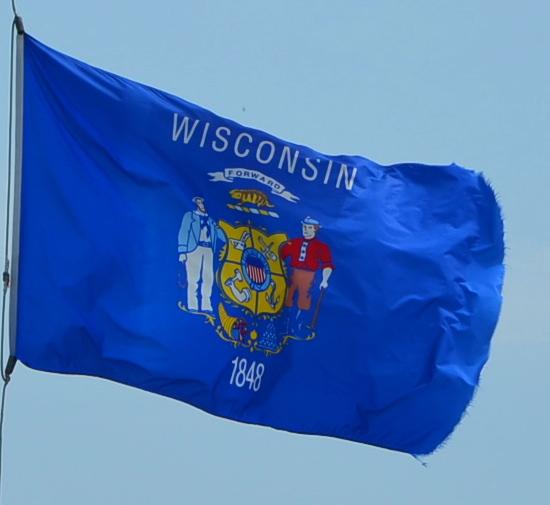
The great seal of Wisconsin was created in 1851 and features the state coat of arms (which also appears on Wisconsin's state flag). All State Seals
Symbols on the State Seal
The banner above the shield displays Wisconsin's state motto: "FORWARD." Directly below this is a badger (the state animal). Supporting the shield are a sailor and a miner (the two most important industries of the state at the time it was founded).
The center of the shield features the United States shield and the motto "E Pluribus Unum" (one from many). The pick and shovel are symbols of the early lead mining industry; galena (lead ore) is the state mineral of Wisconsin. The mining of lead ore was the principal occupation of the settlers of early Wisconsin, concentrated in the southwest corner of the state (in what are now the counties of Iowa, LaFayette and Grant - in the 1820's and 1830's, the population of these 3 counties was greater than that of Milwaukee or the east coast of Wisconsin).
A plow represents the farmers and agriculture of Wisconsin; an arm and hammer represent Wisconsin's artisans and laborers; and an anchor is a symbol for Wisconsin's sailing and shipping industry. The western edge of Wisconsin is the Mississippi river (the chief shipping lane of mid-America during the early 1800's) and the upper part of Wisconsin is bounded by Lake Superior (source of the shipping trade for eastern Wisconsin).
Below the shield are a cornucopia - a symbol for the plenty of the state, bars of lead representing Wisconsin's mineral wealth, and 13 stars which symbolize the original thirteen states.