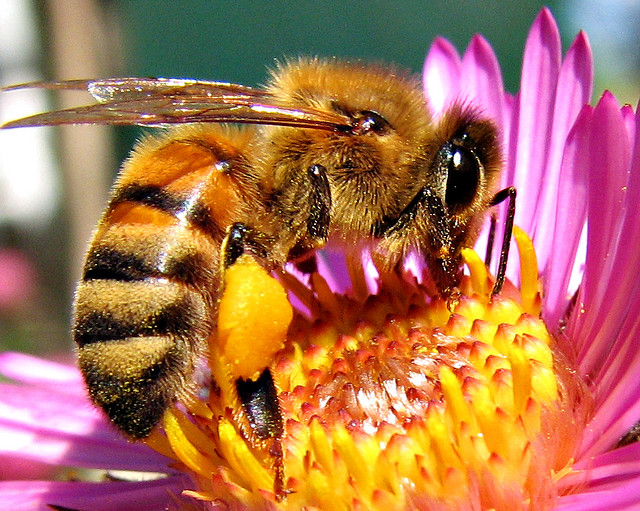
Honeybee on aster flower; photo by mommamia on Flickr (noncommercial use permitted with attribution / share alike).
Official State Insect of Utah
Utah designated the honeybee as official state insect in 1983 due to the lobbying efforts of a fifth grade class. All State Insects
The honeybee is recognized as an official state symbol in 17 states, primarily because honeybees play such an important role in agriculture. Bee pollination is critical to plant and human survival - beeswax and honey are just surplus gifts from this tiny wonder of nature. The plant world expends a lot of energy attracting bees and other insects with brilliantly colored flowers and sweet nectar (nectar is produced solely to attract pollinating insects).
The Hive
Honeybees live in hives of up to 80,000 individuals. A hive consists of one queen bee (who can live 8 years and lay over 1,500 eggs per day), a small group of male drones (on hand to fertilize a new queen on her nuptial flight, should one be produced), and the remaining vast majority of sterile female worker bees.
Young worker bees are called house bees - they construct the hive and maintain the comb, care for the eggs and larvae, tend the queen and drones, regulate temperature, and defend the hive. Older workers are field bees - they gather nectar and forage for pollen, water and plant resins used in hive construction. Worker bees have an extra stomach and special pollen baskets on their hind legs to transport the booty. Empirical evidence suggests that the honeybee "dances" to communicate the location of a nectar discovery to other honeybees. Worker bees only live about 6 weeks in summer months, but honeybees born in fall survive until the following spring.
Origin of Honeybees
The first bees appear in the fossil record dating 40 million years ago and the honeybee has remained physically and socially unchanged for 30 million years. Probably originating in tropical Africa, they were brought to the New World with the first Spanish and English colonists, quickly escaping to the wild and eventually populating the entire western hemisphere. American Indians called the honeybee "white man's flies."