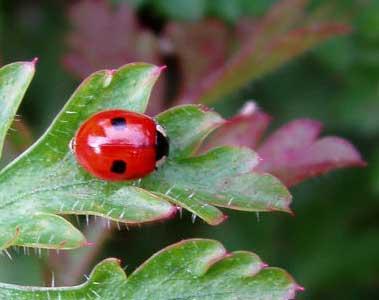
Ladybug; photo by hopeful<3 (ill/off) on Flickr (noncommercial use permitted with attribution / share alike).
Official State Insect of Massachusetts
The ladybug was adopted as the official state insect or insect emblem of Massachusetts in 1974 (thanks to a campaign that began with a second-grade class in the town of Franklin). Because this insect benefits agriculture and delights children everywhere, Ohio, New York, New Hampshire, Tennessee, and Delaware also designate the ladybug as an official state symbol. All State Insects
Ladybugs help gardeners and farmers by eating tiny insect pests that damage plants. A ladybug can consume up to 60 aphids per day, and will also eat a variety of other harmful insects and larvae (including scales, mealy bugs, leaf hoppers, mites, and other types of soft-bodied insects), as well as pollen and nectar.
Also called lady beetle, ladybird, or ladyfly, the most common variety of ladybug found in Massachusetts is the two-spotted lady beetle (Adalia bipunctata). According to John Losey, a Cornell University entomologist who leads the Lost Ladybug Project. (a project funded by a National Science Foundation grant recruiting citizen scientists, particularly children, to search for nine-spotted ladybug and other ladybug species and send photos of them to Cornell for identification and inclusion in a database), there are about 5,000 species of ladybugs, also known as ladybird beetles, with about 450 species in the United States.