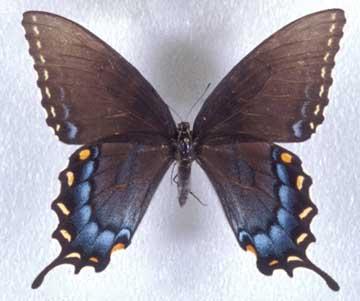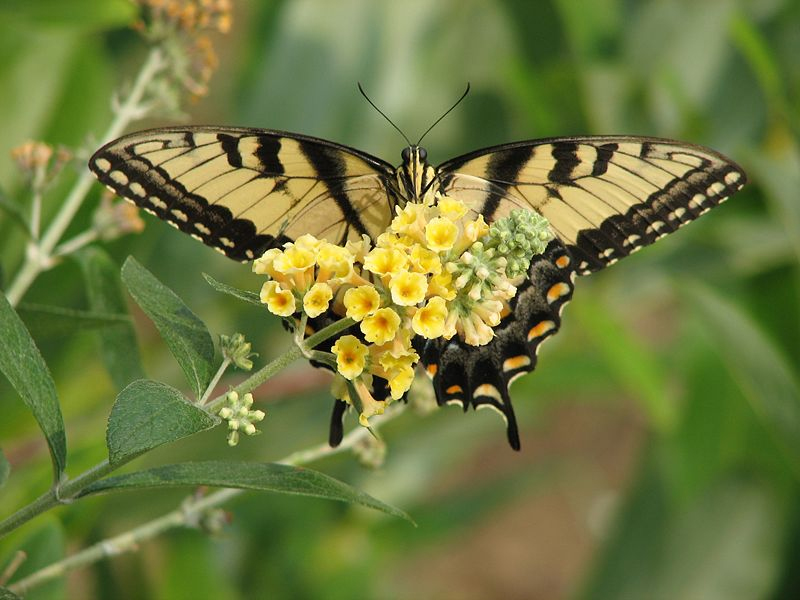
Tiger swallowtail butterfly; photo by Ltsheers on Wikipedia (use permitted with attribution / share alike).
Official State Butterfly of Delaware
The brilliant tiger swallowtail butterfly (Pterourus glaucus) was designated the official state butterfly of Delaware June 10,1999. The tiger swallowtail butterfly is indigenous to Delaware and can be seen in deciduous woods, along streams, rivers, wooded swamps, and in towns and cities throughout the state. Alabama, Georgia, South Carolina, and Virginia also recognize the tiger swallowtail butterfly as a state symbol. All State Insects
Three butterflies were chosen by students of the Richardson Park Learning Center as possible state butterflies, and a vote that included students throughout the state elected the tiger swallowtail as Delaware's butterfly symbol. Two more insects are official symbols of Delaware: the state bug and the state macroinvertebrate.
Tiger Swallowtail Butterfly Facts
Female tiger swallowtails are often mostly black or brown (mimicking the poisonous pipevine swallowtail butterfly), however, females can also have yellow and black tiger stripes very similar to the males. Females lay their eggs on host plants that include yellow poplar, black willow, black cherry, American hornbeam, red maple, spicebush, American elm, and sassafras.
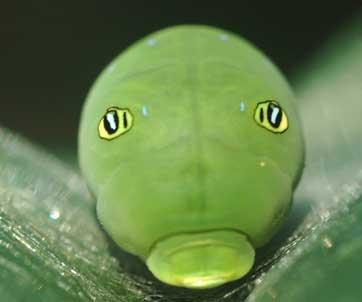
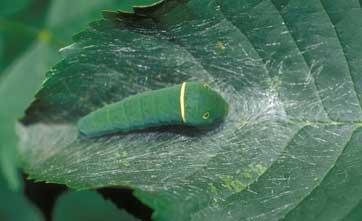
When the eggs first hatch, tiger swallowtail caterpillars resemble bird droppings (an effective camouflage from predators). As the caterpillars grow, they turn green with a large head and bright "eyespots" (not actually eyes, but another tactic to discourage attackers). Many predators eat tiger swallowtail caterpillars including birds, squirrels, raccoons, and shrews.
Adult tiger swallowtail butterflies drink nectar from flowers (including milkweed, thistles, Japanese honeysuckle, ironweed, and red clover). In this way butterflies help with plant pollination and many people plant flower gardens specifically to attract these beautiful insects.
CHAPTER 44, FORMERLY SENATE BILL NO. 85
AN ACT TO AMEND TITLE 29 OF THE DELAWARE CODE RELATING TO THE DESIGNATION OF TIGER SWALLOWTAIL AS THE OFFICIAL STATE BUTTERFLY.
BE IT ENACTED BY THE GENERAL ASSEMBLY OF THE STATE OF DELAWARE:
WHEREAS, many states across America have designated an official State butterfly to accompany their State flag, State flower, State bird and State bug; and
WHEREAS, the State of Delaware, despite its great wealth of indigenous butterflies, has never made such a designation; and
WHEREAS, the students of the Richardson Park Learning Center, aware of this fact, have suggested that the Tiger Swallowtail because of its beautiful black and orange colors would be especially appropriate as the subject of such designation; and
WHEREAS, the tiger swallowtail, a large, yellow, black-striped butterfly, is one of the most familiar butterflies in North America, is one of the most common and conspicuous butterflies in the Eastern United States; and
WHEREAS, Tiger Swallowtail is indigenous to Delaware and can be seen in deciduous woods, along streams, rivers, and wooded swamps, and in towns and cities throughout Delaware; and
WHEREAS, as a result of voting of 3,175 public and parochial students from all over the state of Delaware, of the three butterflies that were chosen as finalists for adoption by the students of Richardson park learning center the Tiger Swallowtail was chosen by 1,611 students; and
WHEREAS, the butterfly herein designated as the official State butterfly is emblematic and fitting to accompany Delaware’s other official symbols, and
WHEREAS, the designation of Tiger Swallowtail would be highly appropriate not only in its own right, but as a means whereby Delaware State government might recognize the increasingly vital role played by natural wildlife in Delaware;
NOW THEREFORE; BE IT ENACTED BY THE GENERAL ASSEMBLY OF THE STATE OF DELAWARE:
Section 1. Amend Chapter 3, Title 29, of the Delaware Code by adding thereto a new section designated as Section 315 to read as follows:
Ҥ315. State butterfly.
The tiger swallowtail (Pterourus glaucus) is the official butterfly of the State.”
Approved June 10,1999